
Private nonprofit · College
Le Moyne College
Syracuse, New York · Large suburb
- 83.0%
- Admit rate
- $22,277
- Avg net price
- 73%
- Graduation rate
- $62,731
- Median earnings
Le Moyne College is a private nonprofit bachelor's-granting institution in Syracuse, New York (large suburb setting), enrolling 2,439 undergraduates. It has a Roman Catholic religious affiliation.
Will you get in?
See where your numbers land against Le Moyne College's admitted students.
- Admit rate
- 83.0%
- SAT (mid 50%)
- 1160–1330
- Avg GPA (est.)
- 3.53
Enter a test score to see where you land against Le Moyne College's admitted students.
A guide, not a prediction. It compares your numbers with the middle 50% of admitted students and Le Moyne College's overall admit rate — it can't see essays, recommendations, activities, or your intended major, which all move real decisions.
About Syracuse, New York
Syracuse is a city in New York, United States, and the county seat of Onondaga County. At the invitation of the Onondaga Nation, one of the five nations of the Iroquois Confederacy, a Jesuit priest by the name of Simon Le Moyne, accompanied by soldiers and coureurs des bois, including Pierre Esprit Radisson, set up a mission, known as Ste. Live jazz music is the centerpiece of two annual outdoor festivals in Syracuse, the Syracuse Jazz Festival, Polish Festival as well as the CNY Jazz Arts Foundation's Jazz in the Square Festival. (Wikipedia)
- Setting
- Large suburb
- Highest degree offered
- Graduate
- Nearest big city
- 3 miles to Syracuse, NY
- To Great Lakes shore
- 34 miles
- Nearest airport
- 4 miles to Syracuse Hancock (SYR) · major hub
How Le Moyne College compares
More selective than 39% · #102 most selective of 137 in New York
Higher than 71%
Higher than 83% · #40 of 159 in New York
Higher than 72%
Higher than 73% · #61 of 133 in New York
Cheaper than 39% · #89 cheapest of 153 in New York
Lower than 53%
Lower than 59%
Larger than 63%
Percentiles compare Le Moyne College with the nation's 2,196 four-year colleges, among schools reporting each statistic. State ranks count four-year colleges in New York.
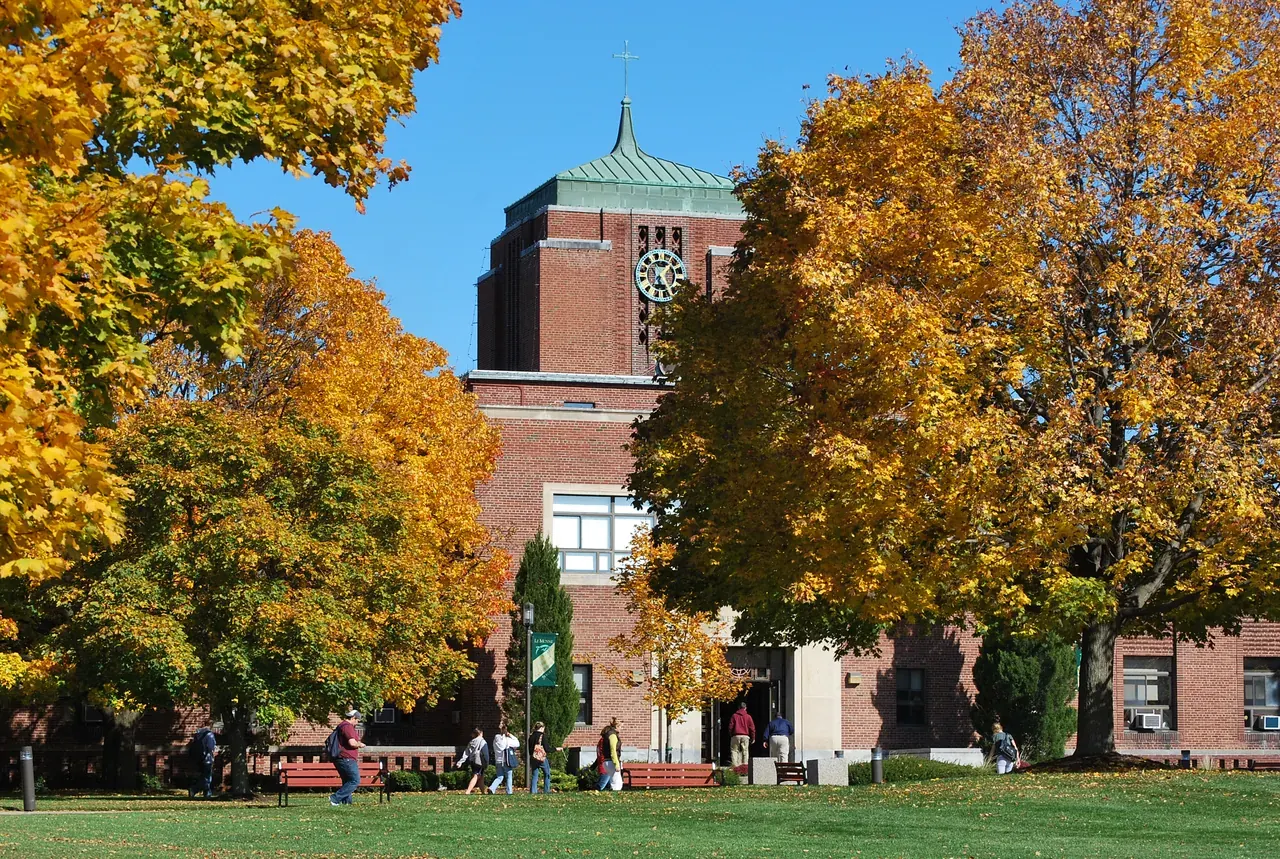
Le Moyne College campus
Student body
Undergraduate vs. graduate
- Undergraduate2,43981%
- Graduate56219%
Undergraduates by gender
- Women1,46860%
- Men97140%
Undergraduates by race / ethnicity
- White72%
- Black7.8%
- Hispanic8.5%
- Asian4.3%
- Other or multiracial7.4%
Graduate gender splits aren't published in this data, so the gender chart covers undergraduates only.
By the numbers
- Undergraduate enrollment
- 2,439
- Graduate enrollment
- 562
- Student–faculty ratio
- 12 : 1
- Pell Grant recipients
- 31%
- First-generation students
- 22%
- Students over 25
- 7%
- Median family income
- $74,353
- Avg faculty salary (academic year)
- $81,738
- Endowment
- $271,730,113
Colleges don't publish true class-size data; student–faculty ratio (IPEDS) is the closest public measure of it.
Admissions
- Admission rate
- 83.0%
- Test scores
- Considered but not required
- SAT range (25th–75th %)
- 1160–1330
- SAT average
- 1255
- SAT reading
- 580–670
- SAT math
- 580–660
- ACT composite
- 25–30
- Average GPA (estimated)
- 3.53
Cost
- In-state tuition
- $40,330
- Room & board
- $16,210
- Books & supplies
- $1,345
- Total cost of attendance
- $53,183
- Average net price
- $22,277
Net price is the total cost minus grants and scholarships — what students actually pay. It varies sharply by family income; see the breakdown below.
Outcomes
- Graduated (within 6 years)
- 73%
- Graduated on time (4 years)
- 65%
- First-year retention
- 84%
- Transferred to another college
- 0%
- Median earnings, 6 years after entry
- $53,493
- Median earnings, 10 years after entry
- $62,731
- Median debt at graduation
- $23,000
- Students with federal loans
- 64%
- Paying down their loans (1 year in)
- 64%
About 8% of students who finish here need more than four years — each extra year adds roughly another year of tuition and living costs.
Graduating on time
By student background (4 years)
When these bars run close together, students from every background tend to finish at similar rates — a sign the school supports the ~30% who are first-gen or low-income.
Campus life & athletics
- On-campus housing
- Yes
- Dorm capacity
- 1,520
- Dorm capacity vs undergrads
- 62%
- Housing charge (year)
- $9,760
- Meal plan (year)
- $6,100
- Application fee
- Free
- Athletics
- NCAA Division I without football
- Varsity athletes
- 473 (261 men · 212 women)
Housing and fees: IPEDS 2023–24. Athletics rosters: Equity in Athletics data, 2024–25. Dorm capacity can include graduate and family housing, so the share of undergrads can top 100%.
Varsity sports (10)
Athlete counts per sport, Equity in Athletics data, 2024–25.
Campus safety
- Safety grade
- C
- Reported offenses per 1,000 students
- 2.7 / year
- Violent offenses (2022–2024)
- 10
- Property offenses (2022–2024)
- 15
On-campus criminal offenses reported under the Clery Act, 2022–2024, across 2 campuses (3,091 students). Counts reflect reports, not convictions — schools with strong reporting cultures often show more, so a higher count doesn't simply mean a more dangerous campus.
Reported offenses in an average year
The same 2022–2024 Clery Act reports, divided down to one year.
By offense type, per year
Averages, not a forecast — a single year can run well above or below this. Bars are scaled against this campus's most-reported offense, so they compare types here rather than against other schools.
What you'll actually pay, by family income
Average net price (total cost minus grants and scholarships) paid by aided students in each family-income band.
College Scorecard / IPEDS, most recent year. Family income is total household income; net price covers tuition, fees, room, board and supplies after grant aid, for students receiving federal aid.
Four-year (or more) true cost
Net price for your family's income, projected across the time it actually takes students here to graduate.
$21,107/year × about 4.2 years — most students here don't finish in exactly four, and each extra term adds cost. A planning estimate from net-price and graduation-timing data, not a bill.
Does the school pay you to attend?
Grant aid from the school's own funds — the discount off sticker, on top of any federal or state help.
Le Moyne College discounts heavily: 100% of freshmen are awarded a grant straight from the school, averaging $25,214. For many families the real price lands well below sticker.
Blends need-based and merit aid — IPEDS doesn't split the two, so a high number can mean generous merit scholarships, deep need-based aid, or both. Figures cover 601 full-time first-year undergraduates, 2022–23. Source: IPEDS Student Financial Aid.
Is it worth it?
A rough return-on-investment read from what graduates earn versus what they borrow.
- Median earnings (10 years)
- $62,731
- Typical debt at graduation
- $23,000
- Debt vs. one year's pay
- 37%
- Out-earn a HS grad
- 72%
Typical debt would take roughly 3.7 years to repay at about a tenth of median earnings.
A reasonable return: earnings comfortably clear the debt over a few years for most students who finish.
Earnings are the College Scorecard median for former students (working, not enrolled) 10 years after entry — not a guarantee, and they vary a lot by major. Debt is the median federal loan balance at graduation.
The pay gap here
Median earnings 10 years after entry, split by gender.
Men out-earn women by $13,112 (22%) a decade out.
Federal figures for former students working and not enrolled, 10 years after they first entered. A gap this wide usually reflects which majors men and women here tend to choose — not different pay for the same job.
Campus climate
- Summer high
- 82°F
- Winter low
- 16°F
- Annual rain
- 39.9″
- Annual snow
- 127.8″
Average temperature
HighLowAverage precipitation (inches)
NOAA 1991–2020 climate normals, Syracuse Hancock Intl AP, NY US station (4.3 mi from campus).
What Le Moyne College graduates study — and earn
Median earnings of this school's own graduates 1 and 5 years after finishing each program, and median federal-loan debt at completion (College Scorecard). Small programs are privacy-suppressed (—). Click a major to compare colleges nationally.
Colleges similar to Le Moyne College
Schools with a comparable profile — size, selectivity, cost, and graduate outcomes. Compare Le Moyne College side by side →

Rider University
Lawrenceville, New Jersey · Large suburb · 32 mi to Philadelphia
- Students
- 3,106
- Admission
- 79%
- Net price
- $25k
- SAT
- 1227
- GPA
- 3.5
- Earnings
- $62k

Lebanon Valley College
Annville, Pennsylvania · Small suburb · 20 mi to Harrisburg
- Students
- 1,684
- Admission
- 84%
- Net price
- $27k
- SAT
- 1240
- GPA
- 3.5
- Earnings
- $63k

Bellarmine University
Louisville, Kentucky · Large city · 4 mi to Louisville
- Students
- 2,161
- Admission
- 86%
- Net price
- $21k
- SAT
- 1210
- GPA
- 3.5
- Earnings
- $62k

Susquehanna University
Selinsgrove, Pennsylvania · Distant town · 36 mi to Harrisburg
- Students
- 2,163
- Admission
- 81%
- Net price
- $29k
- SAT
- 1232
- GPA
- 3.5
- Earnings
- $62k

Hope College
Holland, Michigan · Small city · 25 mi to Grand Rapids
- Students
- 3,288
- Admission
- 79%
- Net price
- $27k
- SAT
- 1249
- GPA
- 3.5
- Earnings
- $58k

Bethel University
Saint Paul, Minnesota · Large suburb · 7 mi to Minneapolis
- Students
- 1,871
- Admission
- 88%
- Net price
- $29k
- SAT
- 1249
- GPA
- 3.5
- Earnings
- $64k
Colleges near Le Moyne College

Syracuse University
Syracuse, NY · Private nonprofit · Bachelor's · 15,477 students
Upstate Medical University
Syracuse, NY · Public · Bachelor's · 159 students

SUNY College of Environmental Science and Forestry
Syracuse, NY · Public · Bachelor's · 1,839 students
St. Joseph's College of Nursing
Syracuse, NY · Private nonprofit · Associate · 313 students

Pomeroy College of Nursing at Crouse Hospital
East Syracuse, NY · Private nonprofit · Associate · 173 students

Continental School of Beauty Culture-Mattydale
Mattydale, NY · Private for-profit · Certificate · 152 students
Onondaga Cortland Madison BOCES
Liverpool, NY · Public · Certificate · 354 students

Onondaga Community College
Syracuse, NY · Public · Associate · 4,456 students
Source: US Department of Education College Scorecard (most recent cohorts), IPEDS institutional characteristics, Equity in Athletics (EADA) data, Clery Act Campus Safety and Security data, and NOAA US Climate Normals. Distances are straight-line from campus coordinates. Percentiles compare schools of the same level (four-year vs. two-year) that report each statistic.